You Are Unique. Choose Your Style.
Comfort Lines
A small guide to where to place the measuring tape and what to do with the numbers afterwards.
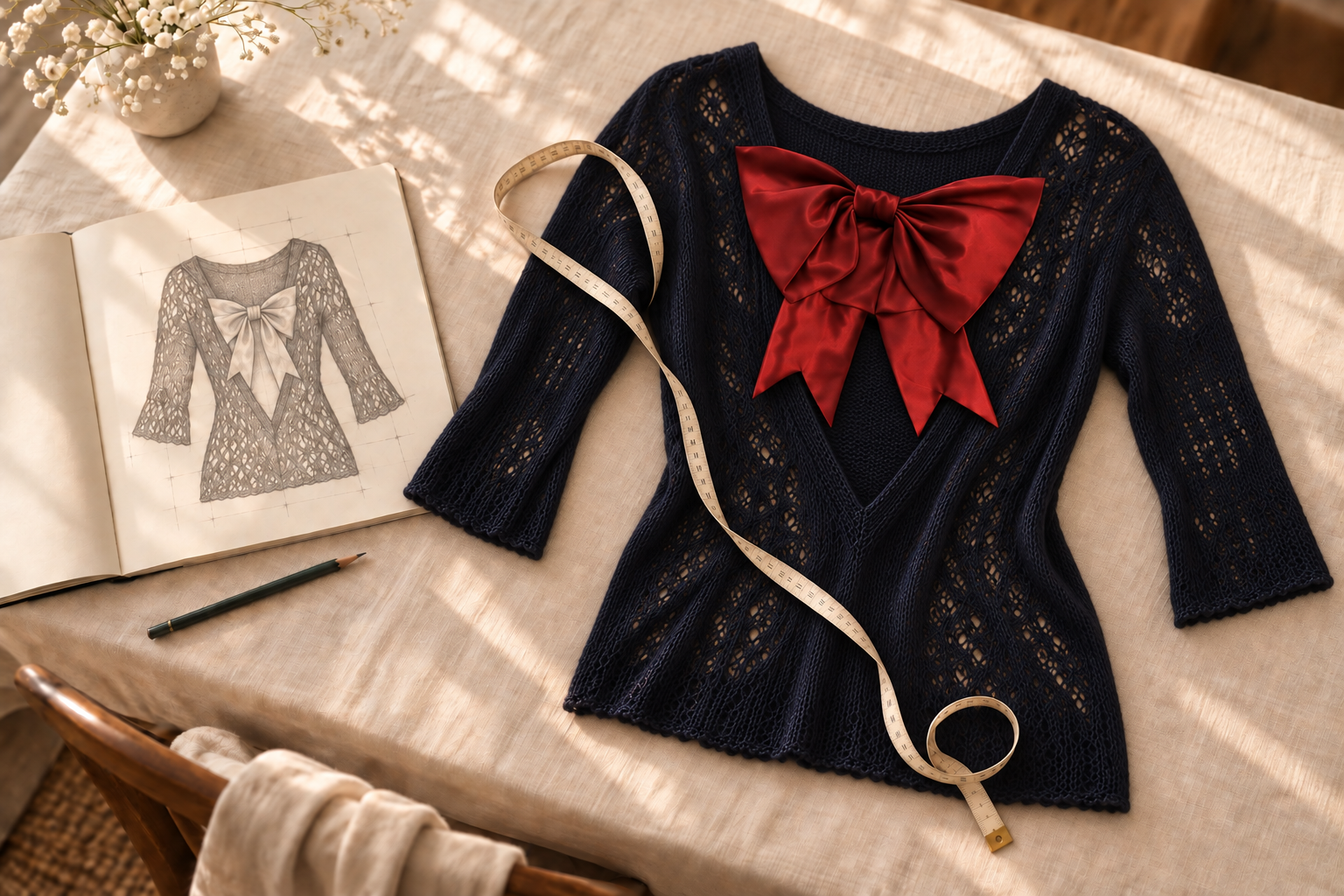
Sweaters with Character
“Comfort Fit” is a general guide. The measurements help you understand how a particular piece is likely to fit.
Here we measure the finished garment, not the body. Width means the distance from one edge of the garment to the other when it is laid flat. It is not a bust, waist or hip circumference.
Two numbers. No mystery.
For example, 52–75 cm:
- 52 cm is the width of the garment unstretched;
- 75 cm is the width when comfortably stretched, not pulled to its absolute limit.
If only one number is shown, the garment either does not stretch or its fit is not intended to rely on stretching.

The Glory of the Bust
The width of the garment at bust level.
The Elegance of the Waist
The width of the garment at waist level, if the garment reaches the waist.
The Luxury of the Hips
The width of the garment at hip level, if it is long enough to actually cover the hips.
The lower edge of a short sweater is not automatically the hip line. We see no reason to give a garment measurements for body parts it never reaches.
Length, Minus the Guesswork
A product page may show one length measurement or two.
One, if the hem ends at the same level. Two, if the sides end at different heights: the shorter side and the longer side are measured separately.
Each length is measured from the top edge of the garment to the bottom edge on that particular side. These are two independent measurements, not the difference between them.
If the length cannot be measured clearly and consistently, we simply do not list it. Better to leave a space honestly blank than pretend there is precision where there is none.
Shoulders Have Their Own Rules
With loose-fitting and asymmetric pieces, shoulder placement, folded cuffs and the construction of the garment itself can all affect sleeve length.
That is why there is no single mandatory sleeve measurement that works for every piece. Look at the photographs too. Sometimes they tell you more about the fit than a measuring tape ever could.
Compare It with Something You Already Love Wearing
Lay your favourite sweater flat without stretching it and compare its width with the measurements shown on the product page.
Do not compare the flat width of a garment directly with your body circumference. They are different measurements.
S, M and L in our “Comfort Fit” system remain general guides. Your bust, waist and hips are under no obligation whatsoever to conform to anyone else’s standards.
Hats
Crown Size

Every queen has a favourite crown.
Take a hat that fits you well, fold it in half and measure along the bottom edge. Multiply that number by two to get the full circumference of the hat.
Alternatively, measure around your head with a tape measure where the lower edge of the hat will sit.
If you like wearing your hair in a ponytail or prefer a fuller hairstyle, remember to leave room for it. A crown should not have to compete with your hair for space on your head.
On Never Standard product pages, the full circumference of the hat itself is already given, so there is no need to multiply those measurements by two.
If a range is shown, the first number is the circumference unstretched and the second is the circumference when comfortably stretched.
Cats & Pups
We measure the finished garment, not the cat or pup. But to check the fit, you will need to measure its future wearer too.


Cat Belly
For cats, use the widest part of the body as your reference point: the belly.
The product page shows the full circumference of the garment at this point. There is no need to double the number.
If a range is shown, it means the circumference unstretched and comfortably stretched, not stretched to its maximum.
Dog Chest
For dogs, use the widest part of the body as your reference point: the chest. Unless, of course, your pup has been particularly enthusiastic about snacks.
The product page shows the full circumference of the garment at this point. There is no need to double the number.
In our clothes for cats and dogs, the chest and belly circumference are the same. You may call us lazy. We prefer to call it consideration for our favourite creatures: clothing should not restrict their movement or interfere with the serious business of being themselves.
A Few Words About Boy Dogs
Because of certain important anatomical differences, a garment for a male dog needs either to be shorter underneath or to have a specially shaped opening.
Male dignity requires a little extra space. Female and feline dignity resides in a proudly raised head and an excellent character, and neither can be measured in centimetres.
From the Base of the Neck to the Tail
This is the length of the garment along the back: from the base of the neck, where it meets the body, to the lower edge of the garment.
We do not measure the tail. It is merely there to point us in the right direction.
Compare It with a Favourite Garment
Take a piece of clothing that already fits your cat or pup well and compare its measurements with those shown on the product page.
If you are measuring the garment laid flat, multiply its width by two to get the full circumference. Do not double the length.
And do look at the photographs. Cats and dogs, just like people, do not always fit neatly into strict geometry.