You Are Unique. Choose Your Style.

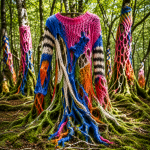
Viscose: from the forest to your wardrobe
The short version: yes, viscose starts with a tree. Somewhere around the same point as paper, cardboard and that receipt you’ve inexplicably been carrying around in your bag for six months. After that, their paths diverge.
Wood cellulose is turned into a spinning solution, which is then formed into fine fibres. Those fibres eventually become a material that drapes beautifully, feels cool against the skin and has travelled quite a long way from the original concept of “tree”.
Viscose has a habit of confusing people. It isn’t quite natural, but it isn’t synthetic in the usual sense either. Its raw material — cellulose — is naturally derived, while the fibre itself is produced industrially through substantial chemical processing.
So what we have is a man-made fibre made from natural raw material.
Not plastic. Not cotton. Not a tree with sleeves.
A category of its own. Entirely.
Why people love viscose
First of all, for the way it feels and behaves on the body.
It’s soft, pleasant, drapes beautifully and generally doesn’t try to build an architectural structure around you. Viscose is particularly good when a material is supposed to flow softly rather than stand rigidly at attention: in dresses, skirts, tops, lightweight jumpers and soft knitwear.
It also absorbs moisture well and can be very comfortable in warm weather.
And it takes dye beautifully. Colours can be rich and expressive because viscose fibres readily absorb dye.
All in all, the material does its best to be liked.
And mostly succeeds.
Because it does have a personality
One important characteristic of classic viscose is that it becomes noticeably more vulnerable when wet.
And this is where the party winds down a little.
Wet viscose is best not wrung out with the expression of someone squeezing the last drops out of fate itself. The fibres lose some of their strength when wet, so rough washing, aggressive wringing and enthusiastic stretching are not particularly welcome.
Viscose garments can also shrink, stretch or change shape — especially if the manufacturer, fabric construction and finishing process have collectively decided to arrange a surprise.
So the care label is clearly not there for decoration.
Does it crease?
Yes.
Sometimes with remarkable enthusiasm.
How much depends on the particular fabric or knit, its composition and the way it has been finished. Viscose blends can behave very differently from 100% viscose.
Which is why two garments labelled “viscose” may have about as much in common as two people who happen to share the same name.
Viscose in yarn
In yarn, viscose often appears in company rather than alone, blended with wool, cotton, linen, polyamide, polyester and other fibres.
It adds softness, a subtle sheen and a beautiful drape.
Sometimes it is exactly what helps a substantial-looking knitted fabric fall beautifully instead of standing around the body with the reliability of medieval armour.
Viscose can also be quite fluid and heavy. As a result, a loose or bulky knitted garment may gradually stretch under its own weight.
Gravity has not been cancelled.
Viscose, modal and lyocell — are they all the same?
Not quite.
They are all man-made cellulose fibres, but their production methods and properties differ.
Modal is generally produced to create a stronger and more stable fibre.
Lyocell is made using a different process and is often known for its strength and softness.
Classic viscose, meanwhile, remains that familiar old acquaintance that can look luxurious, feel wonderful and still demand a certain amount of respect for its personal quirks.
So “viscose”, “modal” and “lyocell” on a fibre label are not three different attempts to confuse the customer. They really are different materials.
What about sustainability?
This is where the attractive phrase “but it comes from trees!” stops telling us very much.
Yes, cellulose is the raw material. But viscose production involves chemical processes, so its environmental impact depends on where the wood comes from, how the fibre is produced, how emissions are treated, how chemicals are handled and plenty of other factors that cannot be determined by touching a sleeve.
A tree at the beginning of the chain does not automatically give a material an ecological halo.
That would be far too easy.
How to care for it
The safest rule is simple: always follow the care instructions for the particular garment.
Viscose generally prefers:
– gentle washing;
– cool or moderately warm water;
– minimal rubbing;
– no aggressive wringing;
– careful drying without stretching.
Knitted pieces are particularly sensible to dry flat, because a heavy wet jumper hanging from its shoulders can occasionally decide, entirely on its own, to become a dress.
So, is viscose good or not?
Yes.
When it is used where its properties actually make sense.
Viscose does not need to be a “substitute for natural fabrics”, nor does it need to apologise for taking a complicated route from tree to wardrobe.
It is a material in its own right, with advantages, drawbacks and a rather eventful biography.
It can be cool, soft, shiny, fluid and very beautiful. It can become temperamental after the wrong wash. And it can work brilliantly in blends with other fibres.
And all of it begins with wood cellulose.
Which means that somewhere far away in a forest, your future little jumper is growing.
It just doesn’t know it yet.