You Are Unique. Choose Your Style.
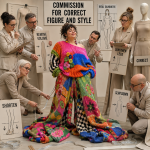
What if I don’t want to look more “correct”?
There is a curious thing about clothing advice: open almost any article on how to dress, and before long it turns out that you should not really be dressed at all. You should be hidden.
Or, at the very least, rebuilt.
If you are short, you must be visually lengthened.
If you are tall, it is apparently best not to make too much use of it.
If you are thin, you should add volume.
If the volume is already there, it must for some reason be concealed immediately.
Widen the shoulders. Reduce the hips. Locate the waist. Lengthen the legs. Emphasise the bust, but not too much. Hide the stomach so thoroughly that it might as well be in witness protection.
And somehow all of this is called “dressing correctly”.
A fascinating idea.
Especially considering that, before the stylist arrived, the person had been existing perfectly successfully in their own shape.
Although the question of the ideal shape is complicated anyway. To a mathematician, for example, the perfect shape may well be a sphere.
So perhaps we should be a little less confident when waving compasses around somebody else’s body.
Clothing as a department of human correction
We have become remarkably comfortable with the idea that clothes are supposed to fix something about us.
They must slim, lengthen, balance, reduce, add volume, soften angles, invent a waist, hide knees and somehow negotiate with the length of the neck.
Sometimes it feels as though a dress is not being bought for a person at all, but for emergency construction work.
Remove something here.
Add something there.
Visually raise the ceiling over here.
And preferably finish by evening, because dinner is at eight.
The funniest part is that “correct proportions” seem to exist in roughly the same mysterious realm as the perfect life, the perfect weight and people who genuinely know how to fold fitted sheets.
Everyone talks about them.
Nobody has really seen them.
What exactly are we fixing?
Suppose someone has broad shoulders.
Why must they be visually reduced?
Did they commit a crime?
Or suppose someone is short.
Why should every item of clothing they own participate in a national programme to manufacture seven extra centimetres?
Tall women are also periodically advised not to “elongate the silhouette”.
Too late.
Nature already did.
Project closed.
A slim person is told they need to “add volume”.
A fuller person is told that the volume must be removed.
At some point you begin to suspect that the ideal human being should be medium height, medium width, medium age and preferably slightly transparent, so as not to disturb anyone with their proportions.
“That doesn’t suit you”
What a magnificent sentence.
Short, confident, and usually delivered as though the speaker has just received official authority from the International Committee on Your Appearance.
“That doesn’t suit you.”
Where is it going?
Why?
Who planned the route?
Sometimes there is genuinely something useful behind the remark. A colour can make a face look tired. The proportions of a garment can fight with the body. A complicated top can quite easily die in unequal combat with even more complicated trousers.
Eyesight has not been abolished.
But there is a fairly large territory between “this outfit is not working” and “you are not allowed to wear this”.
That territory is, more or less, where personal style lives.
Not everything has to make you look better
Here is a thought that is strangely rarely said out loud:
you may simply like the garment.
It does not have to slim you.
Make you look younger.
Lengthen your legs.
Add height.
Reduce height.
Create volume where somebody has decided there is not enough.
Remove it where somebody has decided there is too much.
Point at your “best features” with a teaching stick.
Hide whatever somebody once appointed as a flaw.
You may simply like it.
This is, of course, deeply irresponsible behaviour for an item of clothing.
But occasionally one can take the risk.
You can wear an enormous jumper that makes you look even smaller.
You can wear broad shoulders while already having broad shoulders.
You can wear long clothes while being short.
You can decide not to manufacture a waist on a day when you have absolutely no interest in manufacturing one.
You can even, terrifyingly, stop trying to look like the most commercially advantageous version of yourself every minute of the day.
You are not a flat being prepared for sale.
But some things really do look bad
Of course.
Freedom of taste is not an amnesty for terrible combinations.
Sometimes a colour genuinely fights with your face.
Sometimes a length cuts the figure in exactly the wrong place.
Sometimes two beautiful pieces of clothing meet and immediately turn into a visual family argument.
And sometimes a magnificent complicated jumper meets a pair of loud patterned trousers, and it becomes obvious that one of them has to leave.
Preferably the trousers.
But there is an important difference here.
One thing is to say:
“The composition looks worse this way.”
Quite another is to say:
“Your body is wrong, so we need to visually redesign it.”
In the first case, we are discussing clothes.
In the second, for some reason, we have started editing a person.
And they did not, incidentally, submit themselves for approval.
Beautiful does not always mean “slimmer”
Beauty is generally very bad at accounting.
It does not have to reduce you by two imaginary sizes.
Sometimes volume is exactly what is beautiful.
Sometimes disproportion is the point.
Sometimes a sleeve should be too long.
Sometimes a shoulder should be enormous.
Sometimes a garment should occupy space rather than apologise for it.
Especially when that is the whole idea.
Trying to “correct” such a garment into a safe silhouette is rather like buying a peacock and immediately trimming its tail.
Much more practical.
But then one has to ask: why did you buy the peacock?
The universal figure exists
A mannequin.
It has no preferences, insecurities, bad moods, favourite boots or sudden desire to wear something completely unplanned.
Which makes it very convenient for building rules.
People are more difficult.
They move.
Change.
Age.
Lose weight.
Gain weight.
Slouch.
Stand straighter.
Like themselves today and rather less tomorrow.
And sometimes they buy something simply because the moment they see it, something inside says:
“Mine.”
Which may be one of the most convincing arguments in the entire history of clothing.
Why a little wrongness works
Because the eye likes to find patterns.
And when the pattern is almost there, but someone has carefully shifted one detail, things become interesting.
Best not to disturb the perfectionists at this point. Life is already giving them a nervous twitch.
It is a bit like a perfectly set table with one plate sitting slightly off-centre.
If it was placed there by accident, you want to straighten it.
If it is clearly intentional, you want to know why.
That is the difference between a mistake and a decision.
A mistake asks to be corrected.
A decision asks to be noticed.
So what should you wear?
Something in which you recognise yourself.
Not necessarily the most “flattering” version.
Not necessarily the visually edited one.
Not necessarily the version approved by somebody else’s table of proportions.
Clothing can help build an image. It can emphasise. It can argue. It can calm things down. It can occupy half the room with one sleeve.
But it does not have to correct the person wearing it.
A person is not a draft.
And if someone once again informs you that a garment makes you shorter, wider, taller, thinner or in some other way insufficiently correct, there is always one useful question left:
Who said I was trying to look more correct today?